Repair or Replace? A Vancouver WA Homeowner's Guide to Knowing the Difference
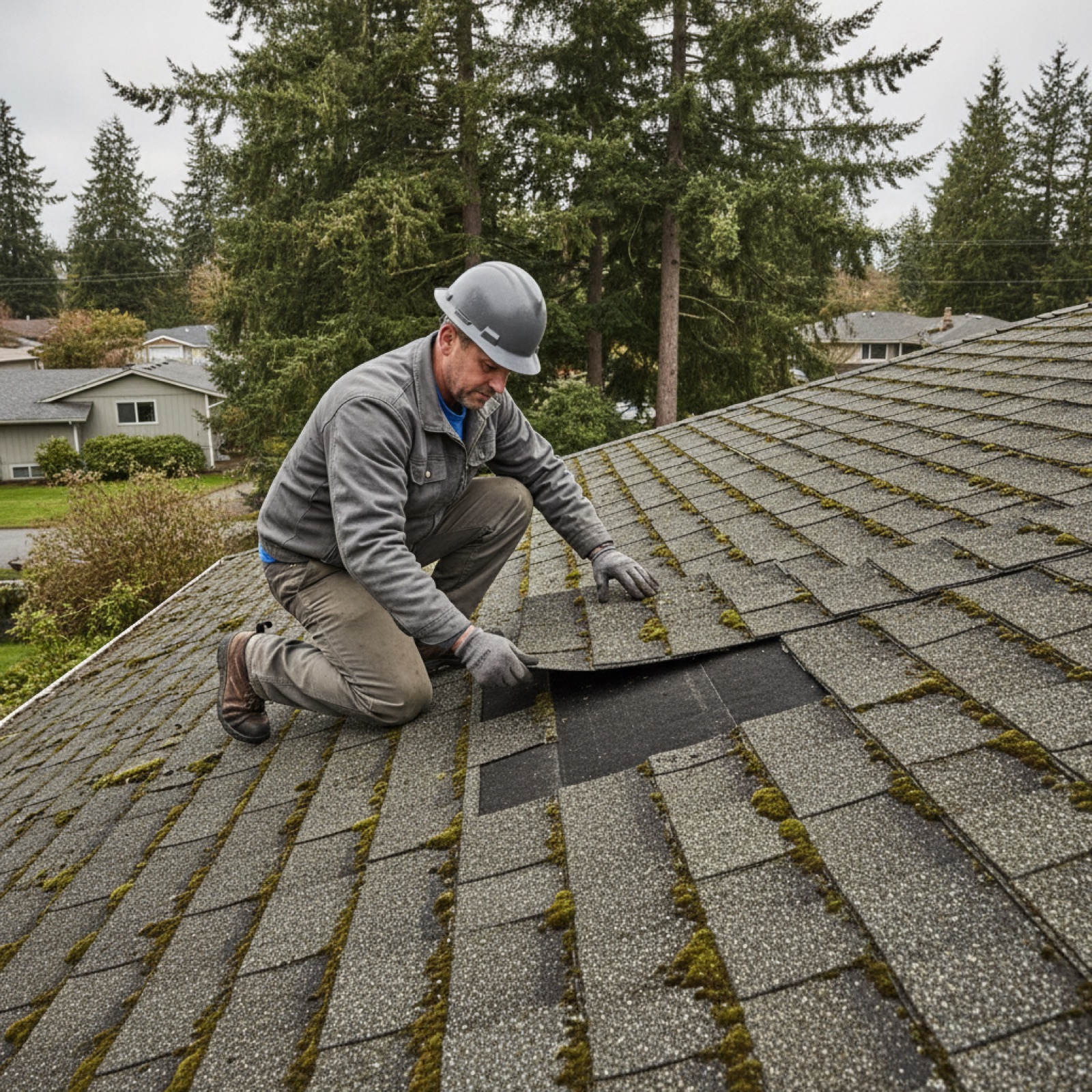
The honest answer to "do I need a new roof?" in Vancouver WA is: it depends less on your roof's age than on how many Southwest Washington winters it has absorbed.
Clark County gets 37 to 42 inches of rain annually, and that moisture does not fall gently. Wind-driven Pacific storms hit north and west-facing slopes with full force, stripping granules unevenly and leaving your roof aging faster on one side than the other. Add a freeze-thaw cycle that runs from the Kelso-Longview corridor up through Vancouver most winters, and small surface cracks become water pathways that grow every time moisture freezes and expands inside them. Nationally, 30-year asphalt shingles are exactly that: 30-year shingles. In the Portland-Vancouver metro, that realistic lifespan often compresses to 18 to 22 years.
That gap is why the repair-or-replace question requires a local answer.
How the PNW Climate Changes the Math on Roof Lifespan in Vancouver WA
An asphalt shingle roof in Phoenix or Atlanta behaves roughly the way its warranty suggests. UV is the primary enemy there, and a well-maintained 30-year shingle often reaches 30 years.
In Southwest Washington, moisture is the enemy, and it attacks from multiple directions at once. Granule loss from rain impact reduces UV protection, which accelerates asphalt oxidation. Winter freeze-thaw cycles open micro-cracks in the mat under those granules. Moss, which grows freely across the Portland-Vancouver metro, works under shingle tabs and lifts them, creating gaps where wind and rain enter year-round.
A roof installed in 2003 or 2004 is not necessarily past its prime, but it is worth a close look. A roof from the mid-1990s in Vancouver WA has very likely earned a replacement, regardless of how it looks from the street.
Age Thresholds: When Clark County Roofs Cross the Line
Use these benchmarks as a starting point, not a final verdict:
- Under 15 years: Repair is almost always the right call unless there is structural damage to the decking.
- 15 to 20 years: Inspect carefully. If granule loss is heavy, moss is established, or more than 20 to 25 percent of shingles show curling or cracking, replacement economics start to beat repeated repairs.
- Over 20 years: Most Clark County roofs in this range are candidates for replacement. Repairs can still buy time, but costs compound quickly.
- Over 25 years: Plan for replacement. Any repair at this stage is short-term bridge work, and you should factor that into what you spend.
These thresholds shift downward for Cowlitz and Lewis County homeowners. Heavier snowload events in those areas add compounding stress on shingles already dealing with moisture cycling, shortening practical lifespan further.
Four Signs Your Vancouver WA Roof Needs Replacement, Not Repair
1. Granule loss in the gutters or at downspout exits. A few granules after a storm is normal. Sand-heavy deposits after rain, or a visible color shift where sections look lighter than the rest, means the shingle's protective layer is depleted. Once that layer is gone, UV and moisture hit the asphalt mat directly.
2. Curling or cupping shingles across multiple roof sections. One curling shingle is a repair. Curling across two or more sections, especially on north and west-facing slopes, indicates systemic moisture damage to the underlying mat. Replacing those sections only delays the same problem appearing elsewhere within a few years.
3. Daylight or soft spots in the attic. If you can see pinpoints of light from inside your attic, or if walking your roof reveals soft areas underfoot, the decking itself has water damage. That changes the project from a shingle job to a full tear-off and deck repair, which is effectively a replacement.
4. Repeated repairs in the last three years. If you have paid for two or more repairs in a 36-month window, add up those invoices. If they are approaching 30 to 40 percent of a replacement estimate, the economics have already shifted in favor of starting fresh.
Why Moss and Moisture Accelerate the Decision Timeline in Southwest Washington
Moss is not cosmetic in the PNW. A light surface coating is treatable with zinc strips or a professional application. An established colony, the kind with visible raised edges and thick coverage, is actively prying up shingle tabs. Each lifted tab is an opening where wind-driven rain enters and where freeze-thaw cycles can work the tab further loose over successive winters.
On a neglected asphalt roof in the Portland-Vancouver metro, moss can take a roof that might have had six or eight more years and cut that to two or three. The mechanism is straightforward: moss holds moisture against the shingle surface continuously, not just during rain events. That year-round moisture loading accelerates granule loss, promotes algae growth under the mat, and creates the wet-freeze conditions that crack shingles from beneath.
If moss coverage is heavy and established, factor it into your repair-or-replace calculation. A roof with significant moss damage may need replacement sooner than its age alone would suggest.
What to Expect During a Roof Replacement in Vancouver WA
Clark County requires a permit for full replacements that involve tearing off existing decking. Your contractor handles the permit application, but inspections are part of the process. A permit also protects you at resale: it creates a documented record that the work was done to code.
A typical replacement sequence in Vancouver WA:
- Tear-off of existing shingles and underlayment
- Inspection and repair or replacement of any damaged decking
- Installation of new underlayment (in Southwest Washington, a synthetic or ice-and-water shield product is standard practice given the moisture load)
- Shingle installation, starting at the eaves
- Flashing work around penetrations, chimneys, and valleys
- Final inspection and cleanup
Most single-family homes in Clark County are completed in one to two days, weather permitting. For a detailed breakdown of what drives the final number, the Vancouver WA roof replacement cost guide covers material tiers, pitch, and square footage in this market.
Choosing the Right Material for Southwest Washington's Freeze-Thaw Cycles
Material choice matters more in the PNW than in drier climates.
Architectural asphalt shingles remain the most common choice. A 30-year architectural shingle with Class 4 impact resistance handles the wind and rain load of the Portland-Vancouver metro well. Specifying algae-resistant shingles (look for the "AR" designation) slows moss and algae colonization and extends the interval between treatments.
Metal roofing performs exceptionally well in Southwest Washington's freeze-thaw environment. Metal does not absorb moisture, so it avoids the micro-crack problem that shortens asphalt life here. Moss cannot take root on it. The upfront cost is higher, but the lifespan runs 40 to 50 years with minimal maintenance, which changes the long-term math considerably.
Cedar shake is traditional in the Pacific Northwest but requires more active maintenance in high-moisture environments. Untreated cedar in the Portland-Vancouver corridor will moss over quickly and needs regular treatment to reach its potential lifespan.
For most Clark County homeowners replacing a worn asphalt roof, a quality architectural shingle with AR treatment is the practical choice. If budget allows and you want to reduce future maintenance, a metal roof is worth pricing out.
If you are trying to decide whether your Vancouver WA roof needs repair or replacement, the clearest next step is getting eyes on the decking. Safecover offers free estimates across Clark County, and a roof that looks borderline from the street often has a clear answer once a contractor inspects the underlayment and attic. Contact Safecover to schedule yours.
Free Roof Estimate
Questions after reading this? Our local team is happy to help. No pressure, no obligation.
Request Free Estimate(360) 304-8055Need a Roof Repair or Replacement?
Get a free, no-obligation estimate from our roofing experts today.