How to Evaluate a Roof Replacement Estimate in Vancouver WA Before You Sign
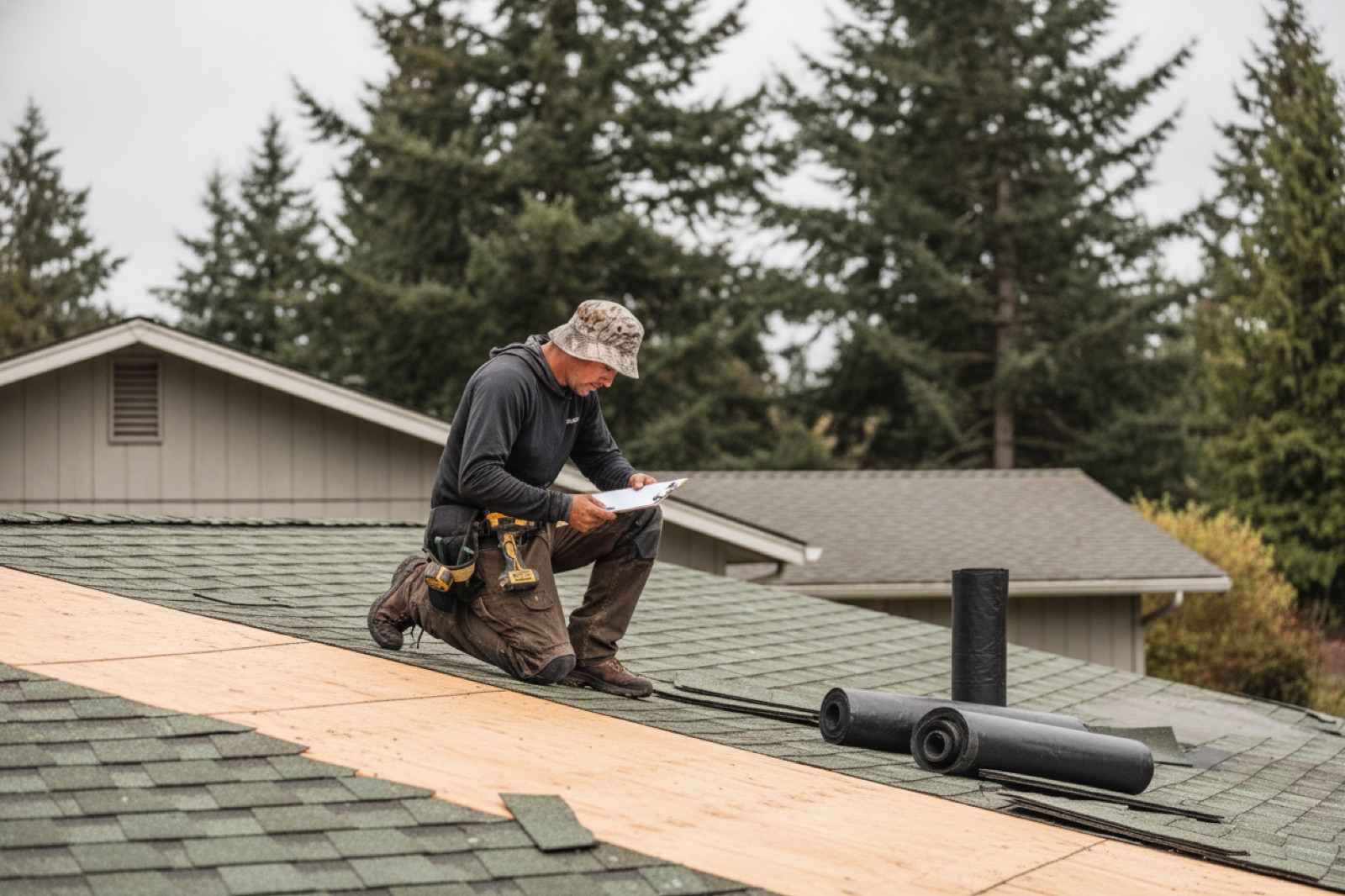
If you are holding a roof replacement estimate and trying to decide whether it is legitimate, the fastest check is this: does it list a permit? In Clark County, a full tear-off re-roof requires a building permit. No permit line means the contractor is either planning to skip it or has not thought that far ahead. Either way, it is a problem worth catching before you sign.
The rest of this guide walks through what a complete Vancouver WA re-roof scope looks like, which Clark County code requirements should appear in every bid, and the specific gaps that separate a thorough estimate from a cut-rate one.
Why a Pulled Permit Is Non-Negotiable for a Full Re-Roof in Clark County
Clark County Building Department requires a permit for any full tear-off re-roof. This is not a technicality. Unpermitted work can surface during a home sale when the buyer's inspector or title company flags the lack of a final inspection. It can also complicate an insurance claim if your carrier asks for proof of permitted installation.
A legitimate contractor pulls the permit themselves, schedules the inspection, and passes the cost through to you as a line item. If a bid is silent on permits, ask directly. If the answer is "we do not bother with permits for roofs," find another contractor.
What a Complete Vancouver WA Re-Roof Scope Covers (Line by Line)
A detailed bid should itemize each component of the job, not just a single price for "new roof." Here is what to look for.
Tear-off and disposal. The bid should specify how many layers are coming off and include a dumpster or haul-away line. A vague "includes cleanup" is not the same thing.
Deck inspection and sheathing replacement. Vancouver homes built in the 1960s through 1980s, common in neighborhoods like Fruit Valley and Orchards, often have aging plywood or board sheathing that shows rot after tear-off. A complete scope lists a per-sheet price for additional decking rather than rolling it into an undisclosed contingency.
Ice and water shield. Under the IRC as Washington State has adopted it, ice and water shield must extend at least 24 inches inside the exterior wall line at the eaves. Clark County's freeze-thaw cycles matter here, especially on north-facing slopes and at the foothills elevations between 300 and 600 feet that cover much of east Vancouver toward Camas and Washougal. The bid should state the product name and where it will be applied.
Synthetic underlayment. This goes over the ice and water shield and across the rest of the field. It should be a named product, not just "underlayment included."
Drip edge at eaves and rakes. Under the IRC as adopted in Washington State, drip edge is required at both eaves and rakes. If a bid scope omits one or both locations, that is a concrete code red flag, not a gray area.
Shingle specification. For a Vancouver WA roof, look for algae-resistant (AR) or copper-granule shingles. Vancouver's persistent overcast and year-round moisture drive moss and algae growth. Specifying a Class 4 impact-resistant or AR shingle is not an upsell here; it is appropriate material selection for the climate.
Pipe boots and penetration flashing. Every pipe that exits through the roof needs a new rubber or lead boot. Every wall-roof transition needs step and counter flashing. PNW moisture makes failed pipe boots a leading source of attic leaks. These should be explicit line items, not buried in "miscellaneous flashing."
Ridge cap and ventilation. The scope should specify the ridge cap product and confirm that existing ventilation will be maintained or improved, not blocked by new material.
Permit and inspection. As noted above: this belongs as its own line item.
Clark County Code Requirements That Should Appear in Every Bid
Beyond the permit and drip edge, two additional code considerations apply specifically to older Vancouver homes.
Attic insulation. Washington State Energy Code (WSEC) may require upgraded attic insulation when a full re-roof is performed on homes with substandard insulation. Your contractor should flag this during the estimate rather than leaving you to find out during the inspection.
Nail patterns and wind exposure. ASCE 7 wind exposure categories vary across Clark County. Open lots near Ridgefield or Battle Ground prairie face higher effective wind pressures than sheltered lots in established Camas or Hazel Dell subdivisions. A contractor who understands this will specify the required nail pattern for your specific site rather than defaulting to a single standard across all jobs.
Red Flags That Signal a Cut-Rate Estimate
A short, low-dollar bid is not always a deal. These gaps are worth treating as disqualifying.
- No permit mentioned anywhere in the scope
- Single lump-sum price with no line items (no way to verify what is included)
- No ice and water shield listed, or only at valleys with no eave specification
- Drip edge missing from rakes
- No deck inspection line item or per-sheet pricing for replacement sheathing
- Pipe boots and flashings absent or rolled into a vague "flashing allowance"
- Shingles listed only as "30-year architectural" with no manufacturer or product name
- No mention of disposal or dumpster
A contractor cutting these items off a written scope is cutting them off the actual job.
Questions to Ask Before You Sign a Replacement Contract
Once you have read through the scope, these five questions will confirm whether the contractor is prepared to do the job correctly.
- Will you pull the Clark County permit, and does your bid include the fee? The answer should be yes on both counts.
- What is your per-sheet price if we find rotted decking after tear-off? A prepared contractor has a number ready.
- Which specific shingle product are you quoting, and is it algae-resistant? Get the manufacturer name and product line in writing.
- How do you handle pipe boot replacements? The answer should be "all boots are replaced as part of the job," not "we replace them if they look bad."
- What is your inspection and final walkthrough process? A contractor who plans on a permit inspection has a process; one who does not will struggle to answer.
Getting a second estimate is worth the time when the numbers between bids differ by more than 10 to 15 percent. Often the gap traces back to one of the line items above.
If you want an itemized estimate on a Vancouver WA roof replacement that covers all of the above, contact Safecover for a free inspection and written scope. No pressure, no obligation, and every line item spelled out before you decide.
Free Roof Estimate
Questions after reading this? Our local team is happy to help. No pressure, no obligation.
Request Free Estimate(360) 304-8055Need a Roof Repair or Replacement?
Get a free, no-obligation estimate from our roofing experts today.