Which Roofing Material Holds Up Best in Longview, WA? A Climate-Matched Replacement Guide
The Short Answer
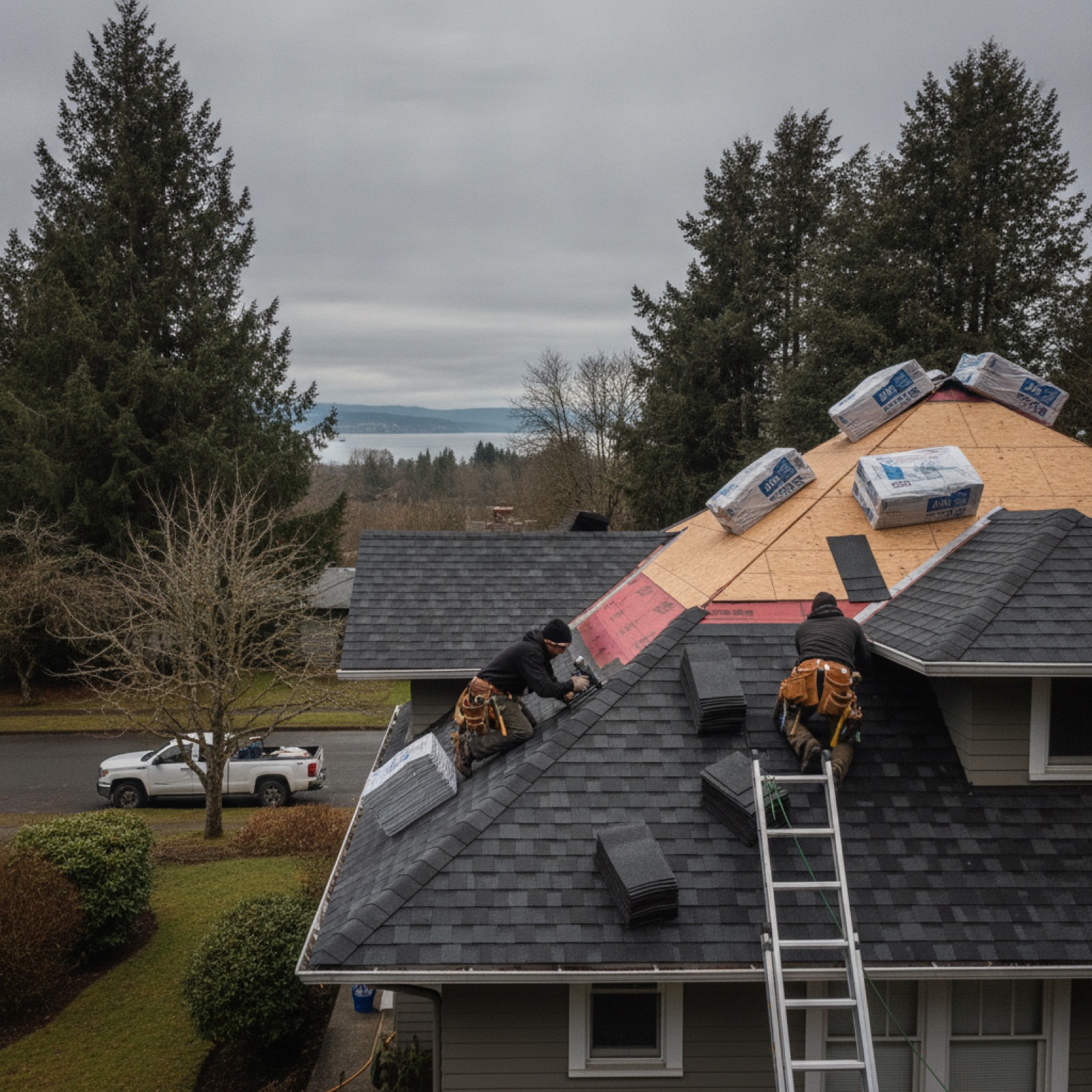
For most Longview homes, a 30-year architectural asphalt shingle with a Class 4 impact rating is the right starting point. Metal roofing earns its higher upfront cost if you plan to stay 20-plus years or if your roof has north-facing planes that stay wet all winter. The choice narrows quickly once you factor in your deck condition, your timeline, and where your house sits relative to the Columbia River.
What Longview's Climate Actually Does to Roofing Materials
Longview averages 46 to 48 inches of rain a year, nearly all of it falling between October and May. That volume alone is not the problem. The problem is the combination of conditions that come with it.
Columbia River corridor wind events regularly hit 40 to 50 mph in fall and winter. Those gusts lift shingle edges, break the factory seal strip, and let water wick underneath. At the same time, Cowlitz County overnight temperatures frequently drop below 32 degrees Fahrenheit while afternoons stay above freezing. That freeze-thaw cycling is hard on flashing sealant and gradually cracks the granule-adhesive bond in cheaper shingle products.
The humidity factor makes it worse. The Columbia River keeps ambient moisture high year-round, so roofs do not dry between rain events the way they would in Eastern Washington. North-facing planes can stay wet for weeks straight through winter. That is a moss and algae environment. Granule degradation accelerates. Organic debris packs into valleys and stays damp.
Material selection that ignores these specifics will cost you years off your roof's life.
Architectural Asphalt Shingles: The Baseline Choice in Cowlitz County
Architectural (laminate) shingles are the right call for most Longview replacements. They are code-compliant, widely available, and contractors working regularly in Cowlitz County know exactly how to install them correctly.
What to look for specifically in this climate:
- Class 4 impact rating (UL 2218). This is the best rating available. It means the shingle passed a 2-inch steel ball drop test and holds up better against debris events in the corridor.
- Algae-resistant granules. Look for shingles marketed with copper-coated or zinc-treated granules. Longview's persistent dampness turns a standard shingle into a moss magnet within five to seven years without chemical treatment.
- Wind rating of 110 mph or better. Many architectural lines now offer 130 mph wind ratings with correct nail placement. On a west- or northwest-facing Longview roof, that spec matters.
- 30-year product line minimum. Under Cowlitz County rainfall exposure, 25-year shingles tend to perform closer to 18 to 20 years. Step up to the 30-year line.
Budget range for a full replacement with architectural shingles in Longview: roughly $8,000 to $16,000 depending on roof complexity and whether re-decking is required.
Metal Roofing in the Columbia River Corridor: Where It Earns Its Cost
Standing-seam steel or aluminum roofing costs more upfront, typically $18,000 to $30,000 or above for a full Longview residential replacement. The value proposition is longevity and moisture resistance.
Metal does not absorb water. Moss has no granule layer to anchor into. The wind resistance of a properly fastened standing-seam panel exceeds any shingle product. In the freeze-thaw environment Longview runs every winter, metal expands and contracts without cracking.
Metal makes the most sense in these situations:
- North-facing or heavily shaded roof planes where moss pressure is constant and shingles degrade faster than their rated lifespan.
- Owners planning to stay 20-plus years. A quality steel panel system lasts 40 to 60 years. On a cost-per-year basis, it frequently beats asphalt over a long hold.
- Older homes where re-decking is already required. If you are already opening the roof to the structure, adding a metal system on a fresh deck is the lowest-friction time to make that upgrade.
Aluminum is worth considering over steel for homes very close to the Columbia riverbanks, where marine-influenced air adds corrosion exposure over time.
Composition and Impact-Resistant Options for High-Wind Exposure
If your home sits in an exposed location, particularly on the west or northwest side of Longview or on elevated terrain near the river corridor, standard architectural shingles may underperform over time.
Class 4 polymer-modified shingles (such as Malarkey Vista or Owens Corning Duration Flex) add rubber or polymer content to the asphalt matrix. They are more flexible in cold temperatures, hold the Class 4 impact rating, and stay in the asphalt price range.
Metal shake or metal tile panels provide the wind resistance of standing-seam in a profile that suits older craftsman or colonial homes common in Longview's historic neighborhoods. They cost more than flat standing-seam but less than premium tile systems, and they read as traditional from the street.
How Your Home's Age and Deck Condition Narrows the Choice
Longview was platted in 1923 as a planned industrial company town, and a large share of its housing stock is from the 1920s through 1960s. Many of these homes were built with skip-sheathing (1x4 or 1x6 boards spaced several inches apart) or rough-cut board decking rather than plywood or OSB.
Skip-sheathing cannot properly support modern underlayment systems or shingles. If your contractor peels back the existing roof and finds skip-sheathing underneath, re-decking with OSB or plywood is required before any new material goes on. That adds cost, typically $1.50 to $3.00 per square foot for materials and labor, but it removes rot risk and gives you a clean substrate the new system can rely on for its full rated life.
Board decking in better condition can sometimes be overlaid with new sheathing, but a qualified inspector needs to assess it first. A roof inspection before committing to material on any Longview home built before 1970 is worth the cost.
What Cowlitz County Permits Require for a Full Replacement
Cowlitz County building codes require a permit for full roof replacements. The permit process covers deck condition and any required re-decking documentation, underlayment type and installation method (self-adhering ice-and-water barrier is required in valleys and at eaves under PNW code), and a final inspection before the job is closed out.
A contractor who skips the permit puts the homeowner at risk at resale and voids manufacturer warranties on most shingle lines. Confirm your contractor pulls the permit and schedules the required inspections as part of their standard process, not as an add-on you have to ask about.
Matching Material to Budget and Expected Stay
| Situation | Recommended Material | |---|---| | Staying 10 to 15 years, standard budget | 30-year Class 4 architectural asphalt | | Staying 20-plus years, sound deck | Standing-seam steel or aluminum | | North-facing or heavy moss history | Metal (any profile) | | Older home, re-decking already required | Metal or premium asphalt on new OSB | | High-wind exposure location | Class 4 polymer-modified asphalt or metal |
The honest reality: the best material is the one installed correctly on a sound deck by a contractor who knows Cowlitz County's climate and permit requirements. A premium shingle with wrong nail placement on a wind-exposed Longview roof will fail faster than a standard shingle done right.
Get an Estimate Specific to Your Longview Home
Material selection depends on what is under your current shingles, your roof geometry, and your exposure. Safecover inspects Longview roofs regularly and can give you a material recommendation tied to real numbers for your specific home.
Schedule a Longview roofing estimate and start with an on-site look before committing to a material.
Free Roof Estimate
Questions after reading this? Our local team is happy to help. No pressure, no obligation.
Request Free Estimate(360) 304-8055Need a Roof Repair or Replacement?
Get a free, no-obligation estimate from our roofing experts today.