Where Is My Roof Actually Leaking? How to Trace a Roof Leak in a Vancouver WA Home
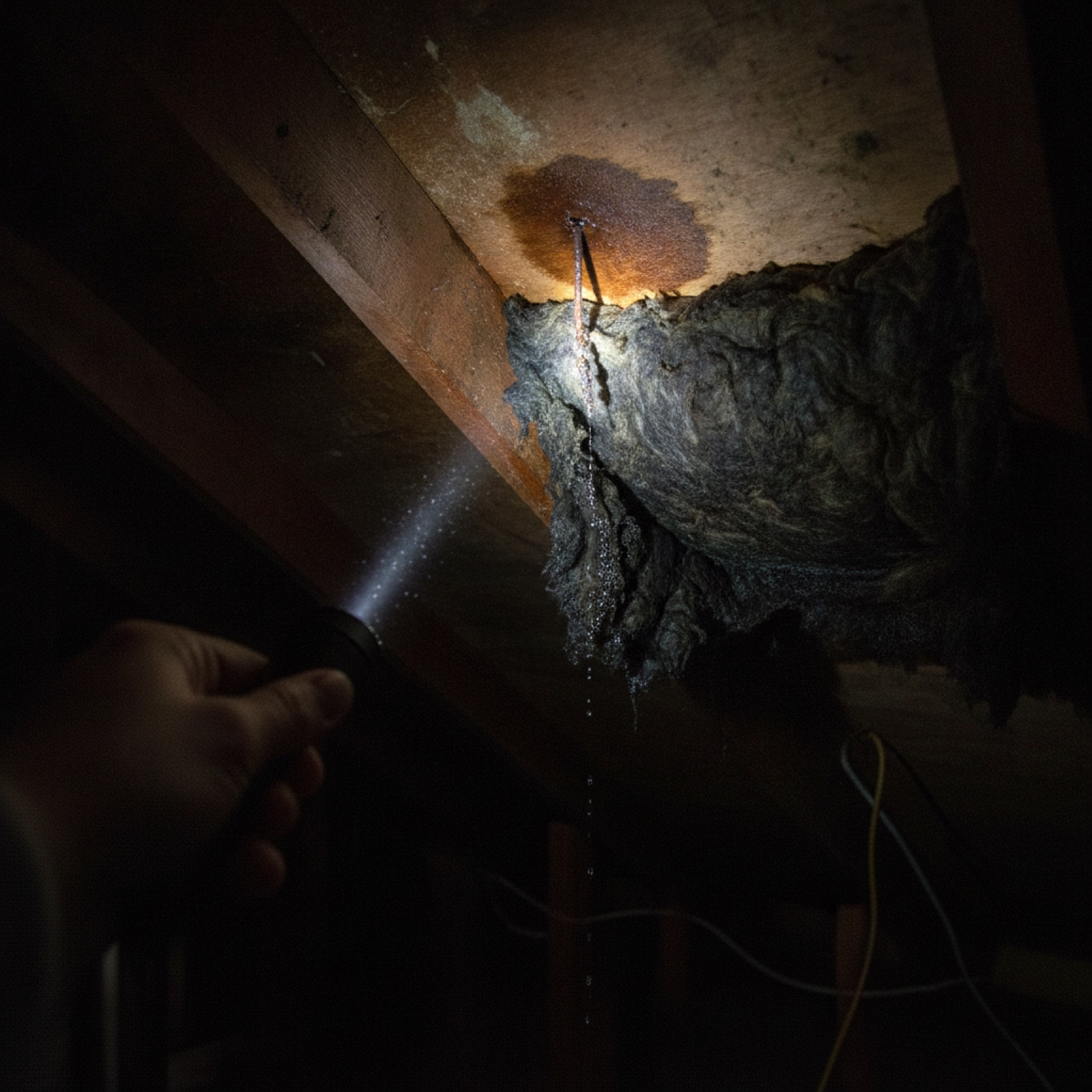
The stain on your ceiling is rarely located directly below where water is entering the roof. In most Vancouver WA homes, water travels several feet along rafters, sheathing, or a vapor barrier before it finds a low point and drips. That gap between entry point and symptom is what makes roof leaks frustrating to diagnose. This guide walks you through how to trace one systematically before you call for roof leak repair in Vancouver WA, or at minimum, how to give a roofer accurate information when you do call.
Why Roof Leaks Rarely Drip Directly Below the Entry Point
Water follows the path of least resistance, and on a pitched roof that means gravity pulls it downhill and sideways along any surface it contacts. A penetration at a skylight on the upper portion of a roof plane can produce a drip near the bottom wall eight feet away. A failed step flashing on the north side of a chimney can saturate the rafter cavity and show up as a stain two bays to the east.
Vancouver WA averages 42 to 45 inches of rain per year, with the bulk falling between October and April. That gives water a long run time. A slow infiltration during a November rain event may not drip until the rafter has absorbed enough moisture to stop wicking, which could be days or weeks later. The delay makes it harder to connect the stain to any specific storm.
Clark County homes built during the 1980s through early 2000s construction boom typically use OSB decking. OSB swells and delaminates faster than plywood once moisture infiltrates. By the time a stain appears on drywall below, the decking above may already show soft spots, dark staining, or visible mold on the underside. The ceiling stain is the last signal in a chain that started at the roof surface.
Start in the Attic: What to Look For and How to Read the Clues
On a dry day after a recent rain, go into the attic with a bright flashlight and inspect systematically. Do not wait for the next storm.
Look for:
- Dark staining or discoloration on rafters and sheathing. Water leaves a tide line as it dries. Follow the highest stain uphill toward the ridge and upslope along the rafter. The entry point is usually somewhere above and behind the stain.
- Soft or delaminating OSB. Press the flat of your hand against the sheathing. Any flex or sponginess indicates moisture damage. Note the location relative to the roof features above it (vents, penetrations, valleys).
- Mold on framing. Black or gray growth typically indicates sustained moisture, not a single event. Chronic leaks often show mold before they show ceiling staining below.
- Wet insulation. Fiberglass insulation collapses when wet and feels heavier than the surrounding sections. Pull it back carefully to check the sheathing underneath.
Mark the location of any suspect area with tape or chalk before you come back down. Measure its position from the ridge and from a gable end so you can correlate it to a specific section of roof surface.
The Most Common Entry Points on Clark County Homes
Once you have a suspected location in the attic, go back to the roof surface and examine what sits above that area. In Clark County, the most common entry points break down this way:
- Step flashing at chimneys and dormers. Each piece of L-shaped metal interlocks with a course of shingles and bends up against the vertical surface. When caulk fails or a piece pulls away, water runs straight down the wall.
- Skylight surrounds. The curb flashing around a skylight depends on both the factory seal and the installer's field flashing. Either can fail.
- Valleys. The crease where two roof planes meet concentrates water flow. Open metal valleys and woven asphalt valleys both fail at different points in their lifespan.
- Pipe boots and vent collars. The rubber collar around a plumbing vent pipe cracks with UV exposure and age. On a south-facing roof, five to ten years is often all the original collar gets.
- Ridge caps. Wind lifts ridge cap shingles, particularly on exposed southwest-facing ridges that catch Pacific storm tracks.
PNW-Specific Culprits: Moss, Wind-Driven Rain, and Flashing Failures
Several failure modes are significantly more common here than in drier climates.
Moss and algae. Growth is endemic on roofs near the Cascade foothills and throughout the Columbia River valley, where shade and persistent moisture support it year-round. Moss holds water against shingles and flashing edges continuously rather than letting them dry between events. It also wicks under shingle laps, lifting them slightly and creating an entry point. If moss is present at a valley or flashing edge, treat it as a suspect.
Wind-driven rain. Pacific storms push rain horizontally. Vertical surfaces, including dormer sidewalls, the sides of chimneys, and skylight surrounds, receive direct water impact that gravity-based waterproofing details were not designed to handle alone. Water enters at these points even when the surrounding shingles are intact.
Cedar shake roofs. Older Vancouver WA and Battle Ground housing stock has a meaningful number of cedar shake roofs. Cedar fails differently from asphalt composite. Shakes split along the grain, and ridge caps open at the center. Valleys fill with debris that holds moisture. If your home has cedar shakes, check the ridge and valleys first.
Freeze-thaw at flashing joints. Clark County temperatures cross 32 degrees Fahrenheit repeatedly in January and February. Caulk and sealant joints expand and contract with each cycle. Over several winters, even correctly installed caulk at chimney counterflashing or skylight aprons develops hairline openings. Water that would drain freely in summer sits long enough in winter to find those gaps.
When You Cannot Find the Source Yourself
If the attic inspection does not produce a clear trail, do not run water on the roof yourself. A garden hose test done without a second person in the attic, isolating sections systematically from low to high, rarely produces useful information and risks saturating framing that was borderline dry.
Two conditions warrant calling a roofer without further investigation: active mold growth on attic framing (which suggests an ongoing chronic leak rather than a recent single event) and soft or collapsed OSB across a section larger than a few square feet. Both indicate damage that needs professional assessment regardless of whether the entry point is identified.
What to Tell a Roofer Before They Arrive
The more specific you can be, the faster the inspection goes and the more accurate the estimate. When you call for roof leak repair in Vancouver WA, have this information ready:
- The approximate location of the ceiling stain (which room, which wall, how far from a corner)
- What you found in the attic: staining on which rafter or sheathing section, any soft spots, mold presence
- When the stain first appeared or when you first noticed it
- Whether the leak appears during any rain event or only during heavy or wind-driven rain
- The age of the roof and the material (asphalt composite, cedar shake, metal)
- Any recent work done on the roof or any penetrations (skylights, solar mounts, satellite dishes)
That list gives a roofer enough to prioritize where to look and whether they need to bring a moisture meter, additional flashing, or materials for a same-day repair.
If you are in Clark County and want a Safecover crew to do the inspection, you can request a roof repair estimate. Bring the attic notes you took and we will work from the same starting point.
Free Roof Estimate
Questions after reading this? Our local team is happy to help. No pressure, no obligation.
Request Free Estimate(360) 304-8055Need a Roof Repair or Replacement?
Get a free, no-obligation estimate from our roofing experts today.